The Rise of the Twigginator.
Editorial note: this is a companion piece to last month's article.
Almost two decades ago, I trained a young woman who completely flummoxed me. I can still remember the gist of the conversation, if not the verbatim dialogue.
It went roughly like this:
Client: Can I look like her?
Me: Who?
Client: The skinny girl.
Me: (after a pause) I don’t know. Can you?
Client: That’s my goal. She’s fit.
Me: How do you know?
Client: She’s skinny.
Me: That’s not necessarily fit. That’s just skinny.
Client: Hmmm. Well, my goal is to look like her.
At that stage of my career, I didn’t possess a lot of finesse or diplomacy (Some might say those qualities are still not readily apparent). My tenure with her didn’t last long. Perhaps I could’ve convinced her that functional fitness is the way to go.
But, sadly, I doubt that. She was one of many, many people that still subscribe to physical ideals that originated half a century ago.
I call this phenomenon “The Revenge of the Twigginator”
The nascent years of Hollywood, (defined here as the 1920’s up to the commencement of World War Two), was really the period of time where iconic male images first became ingrained in the public imagination. These “heroic” figures were almost always white and almost always clothed — no one really had an inkling what they looked like semi-naked. Furthermore, seeing these individuals without clothing might have been to their detriment.
Think of Babe Ruth, undoubtedly among the most famous athletes of the Twentieth Century. He personified the uninhibited, carefree ethos of the Jazz Age. He commanded an enormous amount of money, and he was front-page fodder for an entire decade. Ruth is almost universally acknowledged as the first modern-day sports superstar. In fact, I would argue that the short list for influential male athletes of the Twentieth Century includes just four names: Babe Ruth, Jackie Robinson, Muhammed Ali, and Michael Jordan.
And yet… Babe Ruth had a gut.
He had a pot belly attached to spindly little legs that barely looked capable of supporting his girth. He looked vaguely comical. But Ruth was lauded for his athleticism, not for his physique.
If there was an antithesis to Babe Ruth in the Jazz Age, it was Charles Lindbergh. Where Ruth was garrulous, Lindbergh was an introvert. Ruth partook in all the extravagances of the Jazz Age. Lindbergh, a pillar of rectitude, abstained.
And, while Ruth was fat, Lindbergh was very thin. At least that’s the way he appeared beneath layers and layer of aviation garb. But he had courage and determination, as befitting the man who first traversed the Atlantic on a solo flight. Did Lindbergh have a six-pack? We don’t really know. There is no historical record of it.
What about Joe DiMaggio, so graceful with his baggy pinstripes fluttering in the wind? Again, we don’t know. What about Cary Grant and Clark Gable, icons of the Silver Screen? Always resplendent in fine suits, hair coiffed, and perhaps a drink (or cigarette) in hand. They were admired by women and emulated by men. And, although they were certainly handsome, their physiques were largely a matter of conjecture.
There were a few exceptions, to be sure. Jack Dempsey, the most famous heavyweight of his era, and Johnny Weismuller, the Olympic swimmer who portrayed Tarzan, were semi-clothed in the public eye. But, in comparison to the male archetypes prevalent today, they seem downright scrawny.
Which is odd, because they were both among the most decorated athletes in their respective sports.
What changed?
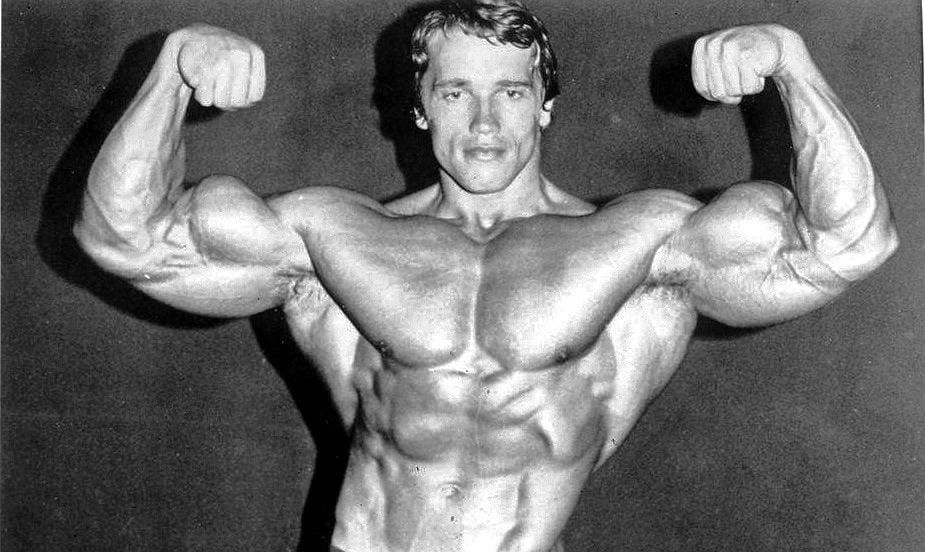
The seismic shift in male beauty occurred in the 1970s, when the Austrian Oak washed ashore Venice Beach.
When the final chapter of Arnold Schwarzenegger’s life is written, it should be a lesson in entrepreneurship. Not fitness. For starters, anyone familiar with his biography knows that a very early age, Schwarzenegger hankered for fame and money. Bodybuilding was simply a conduit to that.
The Schwarzenegger depicted in “Pumping Iron” is Machiavellian. He had incredible tenacity and drive, and he was witty and charming. Charisma through the roof. And, most importantly, he would do what it took to win. Shameless self-promotion. Psychologically tormenting his opponents. Steroids.
And win he did. And, in the process, he began a revolution in how people perceived male beauty. Although there were a few famous bodybuilders before Schwarzenegger entered the scene (such as Eugen Sandow and John Grimek), none had so firmly captured the public’s imagination.
For the first time, body parts became equally, if not more important than the sum of its whole. Historically, this was an anomaly. Never on a scale of this magnitude had male beauty been so thoroughly decoupled from athletic endeavors and accomplishment. Schwarzenegger was famous for looking good…while doing nothing.
“Bodybuilding” entered the popular lexicon as a synonym for fitness. But it’s not.
Have you ever seen a gaggle of bodybuilders hiking the John Muir Trail? Or going on a long-distance bike ride? How about running an 440 or an 880? The point is that bodybuilding rarely correlates to athletic performance, or even everyday fitness. Swollen pecs won’t help you lug several packages of groceries up several flights of stairs. But good core strength and cardiovascular endurance will.
Sadly, with the advent of social media and lookmaxxing, unhealthy male archetypes have gotten much more ubiquitous since Schwarzenegger’s heyday.

The lens through which women have been seen has been more static. Until the past two decades or so, women have always been depicted as the object of male desire. The only thing that has changed — and it was a huge change — was what body type constituted “desirable.”
From the advent of Hollywood through the 1950’s, the curvaceous figure held sway. The Jazz Age “Flapper Girl” was the one exception to the rule. From the turn-of-the-century “Gibson Girl,” through Mae West, Marilyn Monroe, and Jane Russell, women had curves.
Then Lesley Hornby arrived at the epicenter of London’s Swinging Sixties and changed everything
“Twiggy” had one calling card — she was skinny. As in really, really thin. With her big doe eyes, bobbed haircut, and stick figure, she resembled a teen-age boy. She was the “It Girl;” a position she maintained until her retirement from modeling in 1970.
The havoc she left in her wake was incalculable. Teen-age girls everywhere, hungering for a role model, aspired to be equally as thin. The trend to be skinny at all costs — with its attendant eating disorders, emotional trauma, and ruined lives — continued well into the 1990s when model Kate Moss offered her famous riposte to those accusing her of being a bad influence:
“Nothing tastes as good as skinny feels.”
I’ve been a personal trainer for close to twenty years now. Most of my clients have transitioned in late middle-age with me. Aesthetic pursuits are secondary to functional fitness for them. Playing with the kids. Or dogs. Pickleball, surfing, or hiking. Gardening. Taking out the trash.
But the it’s the younger generation I’m worried about. The Twigginator is now on TikTok, still wreaking havoc. And this time with a much wider audience.
Joshua Brandt is an Oakland based personal trainer. He can be reached at joshua@joshuabrandtpt.com or (415) 412-7339.
If you enjoyed reading this article, please pass it along!
Member discussion