My Favorite Fitness Studies Volume One.
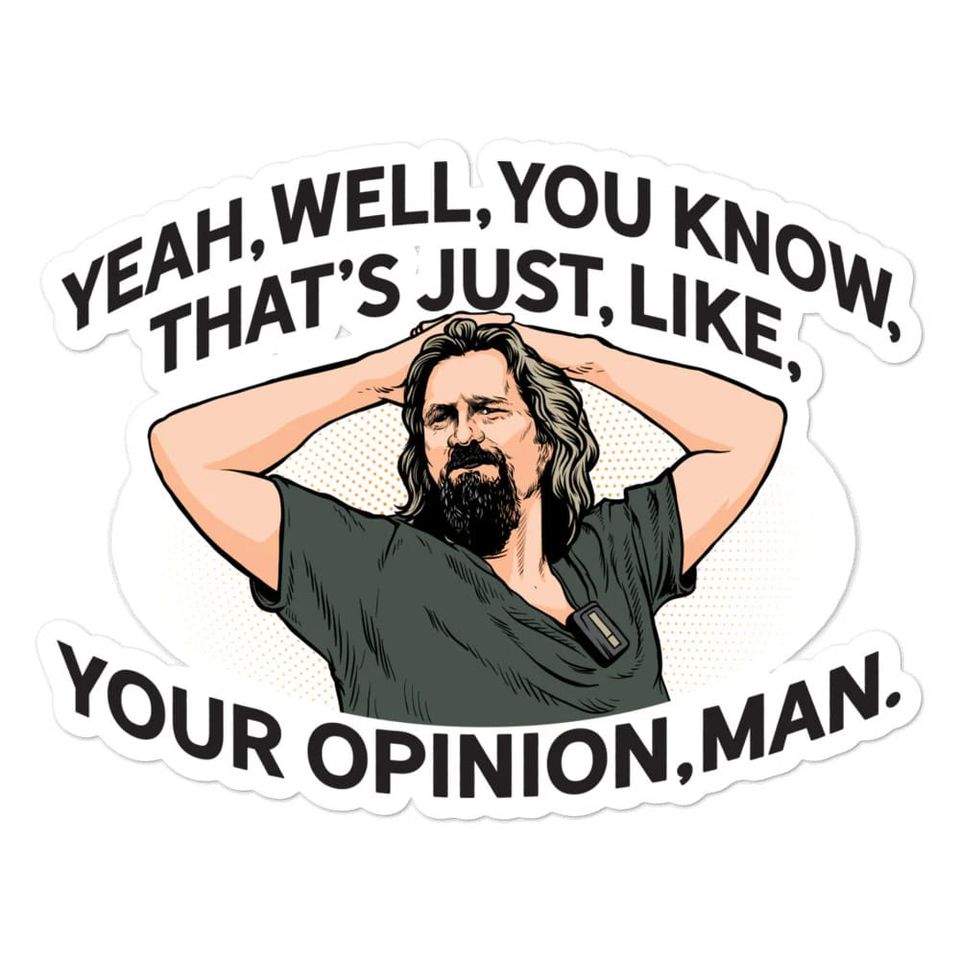
It's one of the most quoted scenes in movie history. In "The Big Lebowski," The Dude (Jeff Bridges) is talking politics and pop culture in a bowling alley with Walter Sobchak (John Goodman) and Donny Kerabatsos. (Steve Buscemi).
The trio is approached by the nonchalant Jesus Quintana (John Turturro) wearing a skintight lavender leisure suit. Quintana unleashes an expletive laden diatribe on how he intends to obliterate the three of them in the bowling game.
The Dude takes the diatribe in stride, and leans back with his hands behind his head. He sizes up Quintana before uttering the quote that launched a million memes.
"Yeah, well, that's just, like, your opinion, man."
Fitness suffers from a similar surfeit of opinions. Almost all of them are missing one crucial ingredient — science. I've read countless articles telling me this is the one exercise that will give you a six-pack, or the three exercises guaranteed to make me feel twenty years younger. Of course, there are never any scientific citations, because, well... it's just an opinion, man. And it's usually not tethered to reality.
Part of my job as a fitness writer is to back up my opinions with facts. Most of those facts come in the form of fitness studies. I wouldn't say that sifting through fitness studies is the most enjoyable aspect of my job. The studies are often turgid, dense, and full of arcane language. But a few studies are truly informative, groundbreaking, and easy to comprehend. Here are two of them, with more of them to follow in future articles.
1) Study: Adult Compendium of Physical Activities (Barbara Ainsworth et. al)
Year published: 1993 (Updated 2000, 2011, and 2024)
The gist of the matter: Can a science-based fitness (movement) study be both fun and informative? That's the Holy Grail of fitness studies. This one comes reasonably close. Its assigns a metabolic equivalent (MET) intensity code to various physical activities (PA.) This is important, because (as I've often argued) the key to fitness is everyday movement — not being sedentary for five days a week and then attempting a marathon on the weekend.
The study classifies sedentary behaviors as 1.0–1.5 METs, light-intensity PAs as 1.6–2.9 METs, moderate-intensity PAs as 3.0–5.9 METs, and vigorous-intensity PAs as ≥6.0.
The findings: Numerous! This is where the fun part kicks in. Are you a cleanliness fanatic? Cleaning or sweeping at a fast, moderate pace will result in a MET Value Score of 3.8. Or, perhaps you have a great sense of rhythm and express yourself best on the dance floor. Afro-Cuban salsa has a MVS of 6.0 and competitive ballroom dancing has a MVS of 11.3.
For the musicologists among us, have you ever wondered which part of the band is exerting the most energy? Well, unless you're Freddie Mercury, AKA the Greatest Rock Front Person in History (I don't need a scientific study to tell me that) the band member getting the greatest workout is often the drummer. Don't believe me? Here's Clem Burke of Blondie. He's a hot, sweaty exhilarating mess. At one point in the video, Debbie Harry glances behind her at the drum set and lets out an appreciative howl. According to the Compendium, drummers score an MVS of 8.3, which leaves the rest of the band in the dust.
Curious about which sports reign supreme in terms of energy expenditure? According to the survey, two sports reign supreme: race walking at a speed of 8.9 mph ("race walking" is where your hips are thrust out at crazy angles) and in-line rollerblading at 15 mph. Those are the only two sports that scored at 15.0 MVS or above.
Any other notable categories? Well, yes. Everyone's favorite...sex! Active, vigorous sex results in a MVS of 5.8. Interpret and utilize that number however you wish.
Caveats: According to the authors, "the standard MET values should not be confused with corrected METs adjusted for differences in age, height, sex, and body mass to calculate personal energy expenditure from standard MET values."
In other words, intense rollerblading as an out-of-shape 55 year-old will result in a different MET score than a highly conditioned 25 year-old. And perhaps a few injuries as well.
2) Study: Countrywide Natural Experiment Links Built Environment to Physical Activity (Abby C. King, Jennifer L. Hicks et. al.)
Year Published: 2025
The gist of the matter: How many times have you heard a trainer or a fitness professional urge people to "just go outside and take a walk?" Well, that's sound advice - but it comes with a huge caveat: some places are much more conducive than others when it comes to "taking a walk." This study analyzed the infrastructure that was most oriented toward pedestrian pursuits. It took a novel approach, tracking 7,400 relocations across 1,600 U.S. cities, and determined how those moves impacted people's ability (or desire) to walk.
According to study author Abby King, a Stanford Medicine Professor of Epidemiology & Population Health, the study "sought to answer an important yet challenging question that the public health field has been attempting to answer for decades, which is whether changes in people’s built environments can actually lead to changes in their physical activity levels."
The answer was a resounding yes.
The study examined the movement habits of over 5,000 people that had relocated to or from cities with a high amount of "walkability" (utilizing the Walk Score Metric) and found that moving to a highly walkable city produced a net increase in walking, while moving to a less walkable city produced a concomitant decrease in walking. The people moving to a more walkable city added over 1,000 steps a day to their routines.
The authors posited that if that all cities had the walking infrastructure that New York City had, about 11 percent more Americans would meet the current U.S. guidelines of 150 moderate-intensity aerobic activity per week.

Caveats: Oh, yeah. There's a big one. Here's a list of the ten most walkable cities in the country, according to Walk Score. The top five cities (in order) are San Francisco, New York, Boston, Chicago, and Washington D.C.
Here's a corresponding list of the ten most expensive cities in the country. All of those most walkable cities are also the most expensive cities, with the exception of Chicago. In addition, Seattle and Portland, which are often lauded for their pedestrian infrastructure and walkability are on the "most expensive city" list.
So, the take-away is that you can walk in these cities ....but you better have $$$$. That's a conundrum that has got to be solved if we want a more egalitarian and successful approach to health and fitness.
Joshua Brandt is an Oakland based personal trainer. He can be reached at joshua@joshuabrandtpt.com or (415) 412-7339.
If you enjoyed reading this article, please pass it along!
Member discussion