Cracking the Code Volume Two: "77 is the New 45."
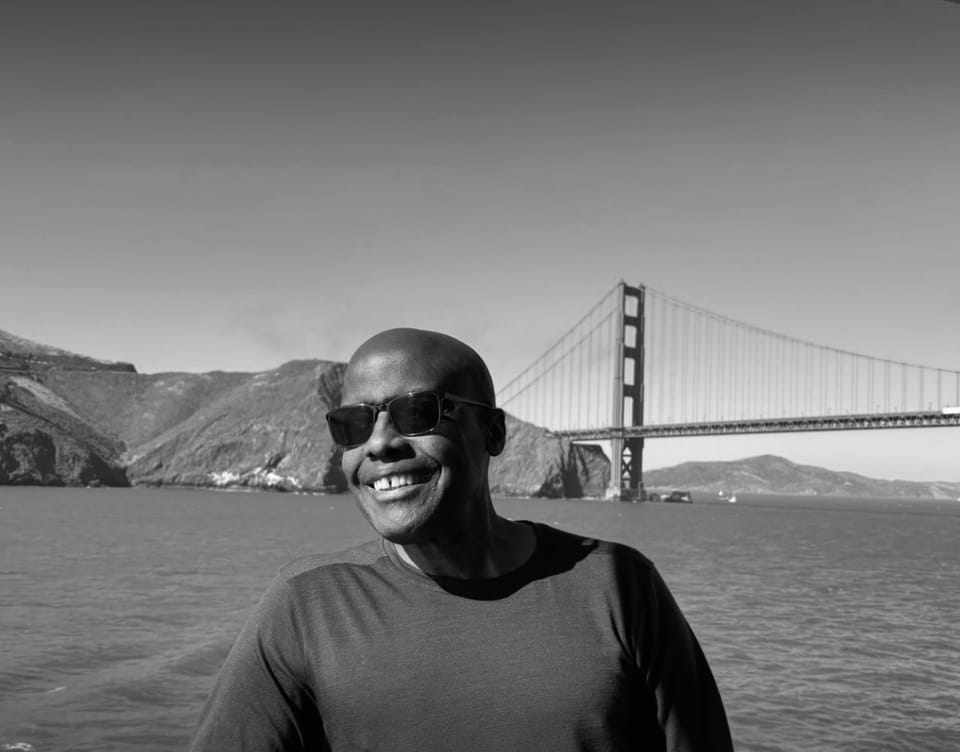
The Mormon Temple in Oakland can be seen from just about anywhere in the Bay Area. It's perched on a huge hill, and its monstrous marble spheres are instantly recognizable even from across the bay.
The reason it's so visible (besides its garish and gothic architecture) is that it sits on a tremendously steep road called Lincoln Avenue. There's a sign at the crest that advises trucks to downgrade due to the 11% grade. In other words: it's catnip for cyclists that really want to test their mettle.
For many years, it constituted the first third of my daily bike ride. It's tough. When I first started, I had to break the climb into "bite size" segments in order to pace myself. I rarely see other cyclists attempting the climb.

But one day...I did. The cyclist came up behind me and appeared to be on the verge of passing me until he sidled up next to me and engaged me in conversation. Now, ordinarily, conversation with a random stranger is not high on my priority list when I'm trying to tackle a huge hill. But it was a beautiful day, and the guy seemed friendly enough.
We got to talking about cycling and fatherhood, and then the cyclist hit me with a surprising fact: he was more than 20 years older than I was. Since I had assumed we were roughly the same age (I was around 48 at the time) that was shocking. But that's how most people react to Kenrick Quamina — with a sense of utter disbelief.
Since that ride more than a decade ago, Kenrick, his late wife Robin, and children Katherine and Matthew have become great friends with our family. So Kenrick was a natural choice to be interviewee for my series on life-long fitness called "Cracking the Code."
Kenrick, welcome to "Beneath the Skin."
Thank you, Josh. It's good to see you.
Just a quick biographical question: you're 77, right?
Yes. I'll be 78 in December.
The first question I have is about exercise habits. Did you always make it a priority to stay in shape and be fit? Is this something that came later in life or was this a lifelong habit?
Fitness has always been a part of my life. Growing up in Trinidad I was a runner. Never in an organized sense, but that's what I did for fun. Racing other kids. I had a lot of "fast twitch" muscles, so it came naturally.
Well, I should say that my father was the one that inspired me initially. He didn’t hold my hands and say I should do anything. I just observed him... you know doing push-ups and sit-ups and that sort of thing. I just saw how he lived and tried to emulate him.
So that was your primary fitness role model?
Yeah. Up until he left the house and moved to London when I was eight. But I always loved moving. So, even after he left I kept those habits. To this day, even if I'm watching a series on TV, I'll have to take a break between episodes to get up and move around. It's very hard for me to sit still.
There's lots of evidence that an inability to sit still for very long has positive health benefits. There's a term for that "NEAT" (nonexercise activity thermogenesis) and I've written about it previously.
(laughs) Well, there you go. That makes sense.
What role did your mother play in your fitness?
Not a lot, really. She was a homemaker and a single mother so she had a lot to do. Maybe she had something to do with my genetics, but fitness was never anything she actively encouraged.
When did you leave Trinidad for the states?
I left Trinidad for New York City when I was 20. I spent fifteen years there. I got my degree in accounting and got heavily into martial arts. Karate.
What prompted the interest in martial arts?
The Seventies was a very violent time in New York City. There was lots of crime, lots of tension, and lots of racism. All of that was really present in Brooklyn, where I lived. New York City taxi cabs wouldn't even go there. You know...the famous "yellow cabs."
So, this whole cottage industry called "Gypsy Cabs" developed. People would put a light on top of their cabs and shuttle people around. It was filling a need for the residents. One night, I saw the driver of a Gypsy Cab being pulled over by a cop. The driver was from Haiti, I think. In any case, there was clearly a language barrier. The cop was speaking to him and the driver didn't understand. Things escalated pretty quickly. The cop started beating the driver with his flashlight. It got really ugly and bloody.
Right then and there, I knew I needed to do something to protect myself. So I started training in Karate. I eventually became a Black Belt. I continued practicing karate until I moved to California around 1982. Then, I switched disciplines to Taekwondo.
Can you elaborate on the distinction between karate and Taekwondo?
Karate is mostly brute force. Lots of punching and kicking. Taekwondo is more about finesse than brute force. More acrobatic. Lots of spins and drops. With karate, I broke a lot of boards with my kicks and with my fists. With taekwondo, it's more about technique, so it's a lot easier on the body.
How has the martial arts training that you've done in the past benefited you today?
Well, flexibility for sure. Flexibility is a big one. People are still amazed by how limber I am. I have a lot of mobility in my hips that I got through martial arts. Lots of range of motion.
But maybe the biggest benefit is mental. I learned focus through martial arts. Obviously, if you're not focused in a practice or match, you're going to get hit. But it's more than that. It observing how to move, how to react, how to gauge you're opponent's technique. How to breathe. Noticing the smaller details. How to be absolutely present in the moment. Those skills helped me in other arenas too. Like parenting, for example. (laughs)
(laughing) Yeah, the ability to regulate your breathing when dealing with your kids is a great skill to have. Let's segue into a sport we both love — cycling. What got you into cycling?
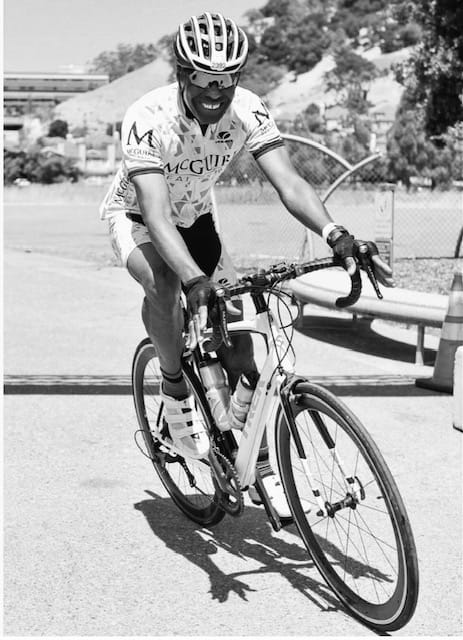
Well, you know it all goes back to my youth in Trinidad. All my friends and neighbors had bikes. But my mother was a single mom, and we couldn't afford bikes. At the same time, there were national champions like Roger Gibbon and Fitzroy Hoyte who were Olympians and trained locally. I grew up idolizing them.
I decided that one of the first things I would do when I had more money as an adult is to buy a bike. But when I was living in New York City, it was just too dangerous to cycle — for many different reasons. So, that dream had to wait until I moved to California.
I first lived in San Francisco, but I didn't get serious about it until I moved to the Oakland Hills. That's where I realized that people cycled up huge hills for fun. That was really eye-opening. My late wife Robin and I also got involved with a group of 40 or 50 people who went up to the Sierras every year to cycle some of those huge passes. That was really hard work. I was already in my early 40s, but I think that was my peak physical condition. I was still doing my martial arts practice and had a cycling training regimen on top of it. But most of that was before parenthood (laughs)
I remember a ride I did with you and my buddy Michael, one of my clients and also a really close friend. He's 74 now, so about three years younger than you are.
Sure, I remember Michael. I remember that ride.
(laughs) I remember you guys were ahead of me the entire ride.
I do remember we rode up South Park.
We did? Man, that's a miserable climb.
Yeah. Michael and I reached the crest of the hill and we didn't see you for awhile. So, we cycled back down to see if you were OK.
(laughing) Well, I seemed to have deleted that incident from my memory. Maybe I was busy taking pictures.
I think you were just testing us. Laying back and waiting to make your move.
That seems like a plausible explanation. I'm going to go with it. Let's segue into another topic you mentioned earlier: parenting and fitness. How did parenthood affect your fitness level or training regimen?
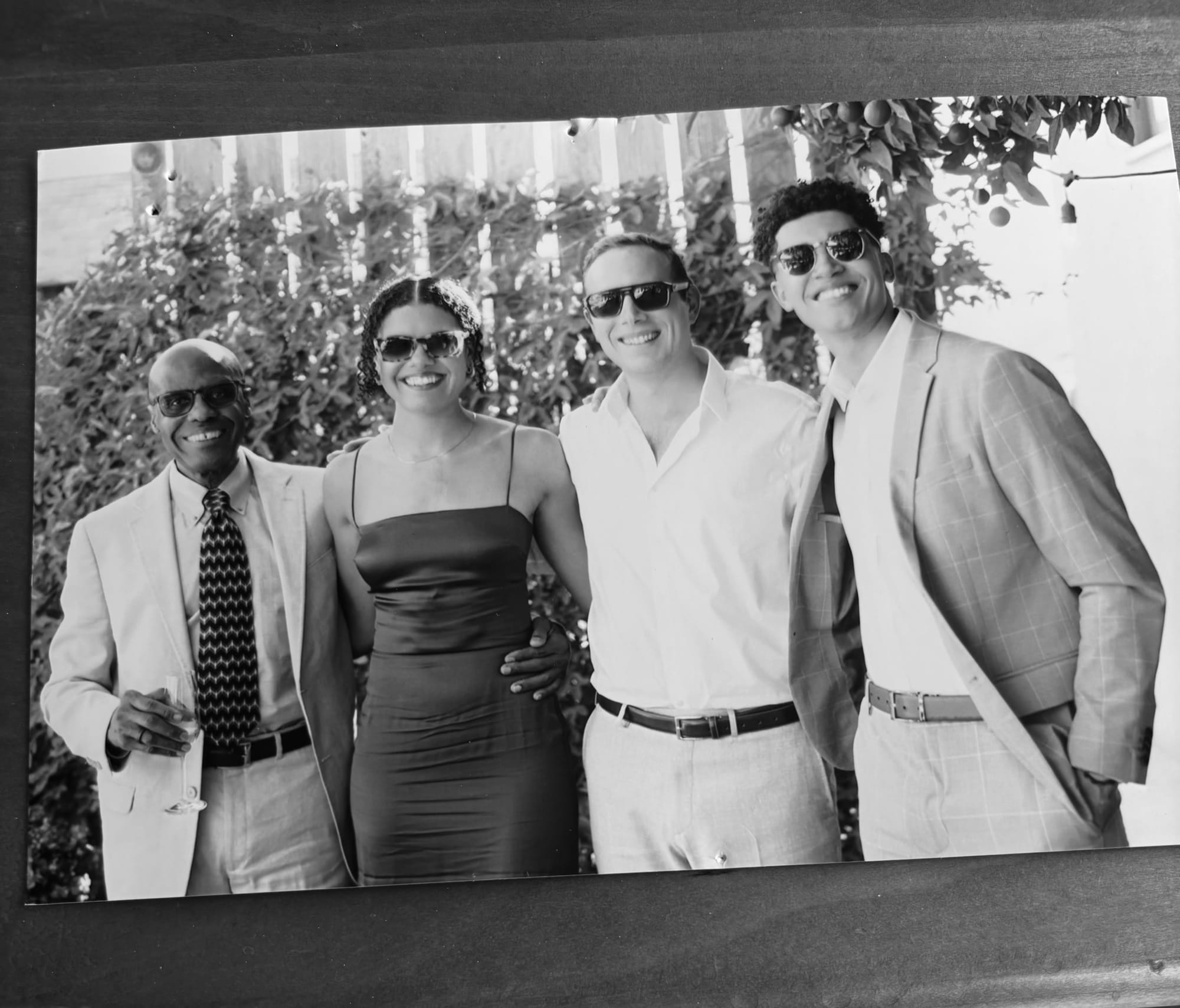
Kenrick with daughter Katherine, son-in-law Galen, and son Matthew.
Well, theres' a lot of joy that comes with family fitness. And a lot of memories. When our kids were born, we were already living up in the Oakland hills. Robin was busy with her clients and I spent the weekends with the kids. They were too young to accompany me in the field so I bought an indoor “cycle roller” and I was able to keep up my cycling regimen and spend quality time with the them. I did martial arts practice at home and they witnessed my commitment and discipline for staying fit.
In their early teens I bought them bikes and thus begun their journey in cycling. I also took them to martial art classes for self defense training. However, my daughter decided from the outset, that when she was old enough to make decisions that she wanted nothing to do with either martial arts or cycling. However, now she's older, she wants to go cycling with me. (laughs)
My son Matthew has been on the road with me and has accompanied me on many rides over the years. Our accomplishments include a few centuries (100 miles) on sanctioned road events. But the most important aspect of family fitness is always the memories we create together.
Funny story. The first time I took my daughter Emmanuelle up Joaquin Miller (the really steep hill that connects with Lincoln Avenue) she was crying. And the second time up she tried to race me. (laughs) Anyway, I remember that first time up, your son Matthew passed us in a car and slowed down to encourage her.
"That's OK," he said. "I was crying my first time up Joaquin Miller too."
I turned to my daughter and patted her on the shoulder. "And that was just last week," I told her.
(laughing) Yeah, Matthew came home and told me that story. Those are the best memories.
Let's go into a different topic. Do you ever recall in your life when you were not in shape?
Well, you know maybe when I first moved to New York. I was just working all the time in a warehouse and not really exercising. I was probably homesick, too. And I was really eating a lot.
Part of that was I grew up hungry. Not really starving, but hungry. I had five siblings with a single mom, so there wasn't a lot of food to go around. So, when I had more income I spent a lot of it on food. I gained maybe 30 pounds in the first year I moved to New York. When I started my karate regimen, I regained my fitness. But that was a pretty brief moment in time. I've always made staying in shape a priority.
How has your training regimen changed over the years?
I'm definitely incorporating much more strength and resistance training in the last 20 years. When I started cycling, I really became a big fan of the Tour De France. At some point, I looked at those guys and they didn't look too healthy. They had no upper body muscle.
I've always ranted about how serious cyclists neglect upper body muscle.
Right. And it's not just aesthetics. It's about living a longer and healthier life. So, I really started focusing on lifting. I've read lost of studies about lifting weights and longevity. And you know...the older you get, the more you're interested in longevity. (laughs)
(Laughing) There does seem to be a correlation.
So, now I focus on bench presses, squats with weights, dead lifts. Things like that. I do some light warm-ups and then try for a set of 1-2 max weight reps. And I also have a "one hour" rule. I work out for an hour a day at a higher intensity.
So, if I'm in the gym, I'm pushing heavier weights at max capacity. Getting my heart-rate up. If it's hiking, then I choose a steep hill. The same thing applies to cycling. If it's a cycling day, I make sure that my route incorporates some really challenging hills. Fortunately, where we live, you have huge hills in every direction.
That's why I could never move to Florida. (laughs)
(laughing) Exactly. And I'm at the point in my life where it's just part of my routine. Just like eating or sleeping. Even if I'm tired, I push through it. I always feel better after. That's the main reason. And the success builds on itself. The more hills I climb, the easier it becomes to do it. Even at my age.
One last question. I remember cycling a few years back. Some guy passed us on a bike and you mentioned that about ten or fifteen years ago, you would've chased him down. How has your attitude toward fitness and competition changed?
I remember that! The answer is pretty simple: I've "been there and done that." I don't have anything left to prove. I'm just enjoying the ride right now.
Member discussion