Cracking the Code Volume Three: The "King of Exercise Snacking" Talks About Overcoming Self-Doubt, Surviving the Slot Canyon, and Taking the Stairs.
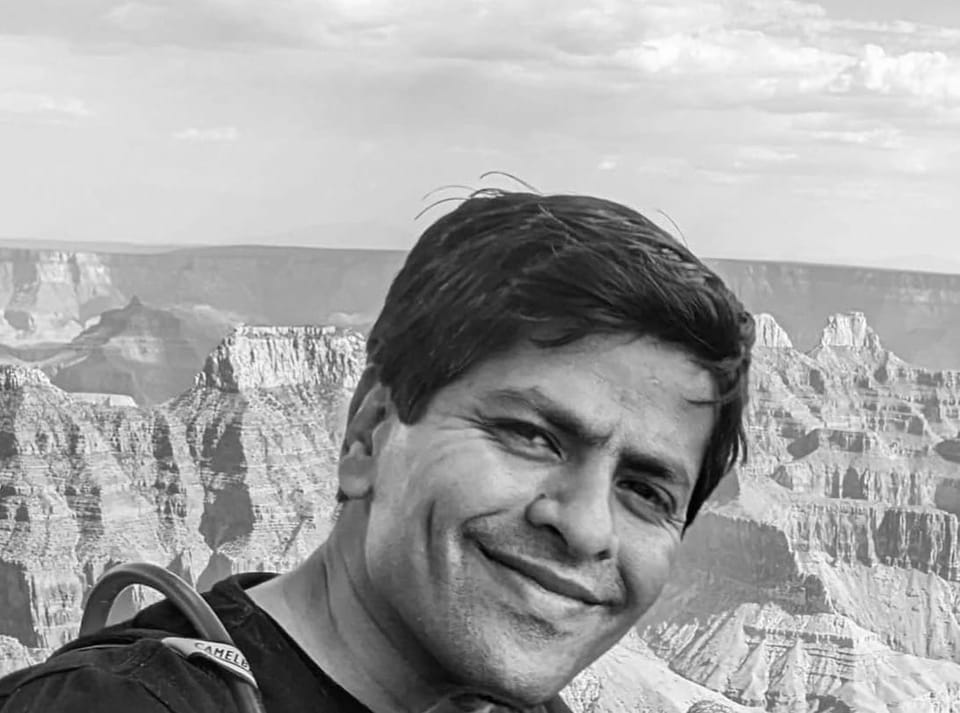
My friend Sukhendu Chakraborty has always been an outlier among my clients. For starters, he's the only one that came to me looking to gain weight. He wanted to put on twenty or thirty pounds of muscle. But there was a caveat - he wanted to do it organically and holistically.
Perhaps you've never been a skinny and awkward teen-aged male. I have. And speaking from personal experience, I wanted out of that body the most expedient way possible. So I was intrigued by Sukhendu's goals. Even though he approached me in his early thirties, I saw him through the prism of my own angst-filled adolescence, and I was eager to accompany him on his journey. In a way I viewed him as a kindred spirit — with one notable exception.
Pound for pound, Sukhendu is one of the strongest people I've ever met. It took him a long time to recognize that, and that's one of the really fascinating aspects of his story.
Sukhendu, welcome to the "Cracking the Code" interview series.
Thanks, Josh.
I want to get a bit of biographical information to start with. Growing up in India, your main passion and athletic activity was playing football (soccer) right?
At school, I played football, but recreationally. The same with cricket. I loved participating in them, but it was at the "hobby" level.
Your dad was a serious football player?
Yes, he was quite good. He was very well-known for his athletic skill in our hometown. He had the option to play professionally. He was also very competitive. He passed those genes along to my brother, who was also quite athletic and competitive. Those genes bypassed me. (laughs)
Well, I'm going to push back on the "athletic" part of that narrative.
(laughing) OK. You've spent years trying to change my thinking on that.
So, athletics was woven into your youth?
No, not really. We were a typical middle-class Indian family, which meant the emphasis was really on academics and studying. That was always the highest priority. Athletics and sports were much lower down on the list.
When you came to the states, you attended Duke in North Carolina. What was your fitness like at that point?
Very bad, actually. I would say that was the unhealthiest I've ever been. I would wake up really late, eat unhealthy food at really random times, and I never had a workout regimen.
Your weight rarely fluctuated, though.
Yes, that's right. I always weighed roughly the same. About 115 pounds.
Ironically, you're one of the few people that could've benefitted from having a gut. It would have been a very visceral reminder that you were getting out of shape.
(laughing) Maybe you're right. I never thought about it that way. (pause) But, one thing I think I should mention since this article is about "exercise snacking." Looking back, although I never went to the gym, I did get plenty of movement in. I never had a car, so I had to walk about three to four miles a day to get back and forth to class about six days a week.
Ha! Exercise snacking again!
Yeah, it just never occurred to me. Walking was always something I just did. It never occurred to me that it was a form of exercise. It was just a matter of necessity.
I'm going to say that unintentional habit made you fitter than most people that go to the gym. But we'll get there.
Let's fast forward a few years to when I met you. This is early 2012, I think. You had just come back from a trip to Africa, and you were looking for a trainer at UCSF, which is the gym where I worked at the time.
It was after that trip that I realized I really had to make some health changes. I had contracted a stomach virus while on the trip that caused me to lose my appetite. My weight really dropped. Also, I didn't have an exercise regimen, so I was constantly feeling lethargic.
My wife Shobana was really the driving force behind me getting a trainer. She did a search for potential trainers, and she liked your biography and your exercise philosophy.
Thanks for bringing that up. We both owe her! I remember when you first approached me at the gym. You told me that you didn't consider yourself athletic. Can you elaborate on that?
Well, I thought in order to be fit, you had to be really ripped. You know, what all the marketing hype makes you believe. I bought into it. To me, fitness was huge, bulging muscles and going to the gym for a few hours a day. Lifting heavier and heavier weights. That kind of thing.
I was always skinny. Built like an endurance athlete. So, I didn't really fit the archetype. That's where I was at mentally when I first approached you.
Was that fitness archetype prevalent in India as well?
I don't know about now, but it definitely used to be. When I was growing up, there was almost a one-to-one mapping between "health" and looking like Arnold Schwarzenegger. My family always told me I needed to bulk up.
So that's a Bollywood archetype as well?
Yeah, for sure.
Given all of your preconceived notions of fitness, I was really shocked when we started working out. I usually emphasize bodyweight exercises, and that really worked to your benefit. I remember you blew through all my advanced core exercises. I had to constantly think of new exercises to challenge you. Your "strength to weight" ratio was off the charts.
(laughs) Yeah, that was pretty eye-opening. I was surprised as well.
It's a common misconception. Look at all the gymnasts. They're not built like Schwarzenegger. They're compact and lithe. Put another way: it's going to be a lot easier to do a pull-up or a push-up if you weigh 150 pounds rather than 220 pounds.
Can you give me a little bit of insight into how your thinking evolved on fitness?
You know, talking with you now makes me realize how much mental baggage I was carrying around. It took a long time for me to get rid of that stuff and believe in myself. It was a process. But I could see the results and the data points. It seemed like every two weeks we had to keep adding weight to the exercises, so it was certainly easy to gauge the progress that way.
I think I finally began to realize that I could be fit and healthy within my own frame. I wanted to gain muscle and weight, but it could be organic and incremental. That was a huge transformation.
So let's talk about one of my favorite "Sukhendu" anecdotes. And this is real world applicability in terms of strength. I think it was a turning point in your self-awareness. I've always loved the story about your hike in Zion National Park.
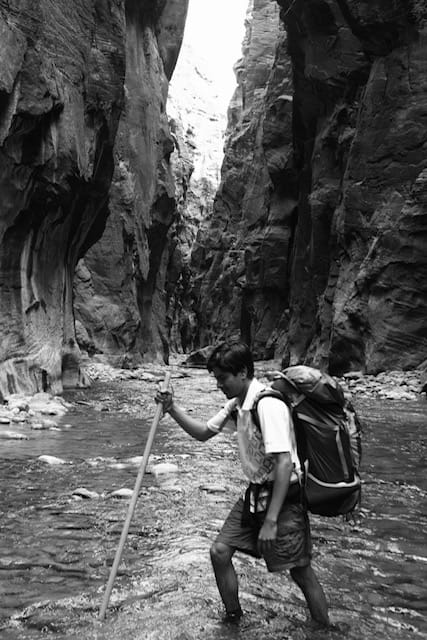
Well, you're talking about the hike I did with my wife more than a decade ago. The most famous hike in Zion is called "The Narrows." It's a slot canyon, surrounded on either side by steep cliffs. Most of the hike involves wading through ankle deep water on slipper rocks, so it's pretty tough.
Just to interject a bit. That particular hike can be incredibly dangerous. There's a risk of "flash flooding" which can turn ankle deep water into ten feet of raging water flows within a matter of minutes. There have been numerous fatalities over the years.
Yeah, it's not something to be undertaken lightly. Before our kids were born, my wife and I did 3-4 pretty serious backpacking trips per year. So, we were experienced. But The Narrows is on a completely different level. We were also wearing backpacks that weighed 25 pounds.
I think we were several miles in when we got word of a thunder burst upstream which could result in a flash flood. We looked around for an escape route but our options were pretty limited. There wasn't any higher ground within easy reach.
Basically, our only option was a huge rock in the middle of the river. We were going to have to make that work. My wife calls me a "mountain goat" because I can scamper up things pretty quickly. That came in pretty handy because we only had a few minutes before the floods were going to reach us.
The rock surface was pretty rough so I was able to drag myself to the top of a little ledge. My wife was struggling, though. She's really tall and outweighed me by about forty pounds. She tried a few times but couldn't get any leverage. I remembered all the core work we'd done and decided "now would be a good time to utilize that training." (laughs)
Since there was nothing to really anchor my feet to, I pushed against the ground as hard as I could to gain some leverage, and extended one arm out. Shobana grabbed my hand and I yanked her up about seven feet in one swift motion. I think we beat the floods by five or ten minutes. It was really close.
I still remember that story years later. It's definitely the kind of story that lodges in your memory banks. I also think that incident permanently eliminated any lingering self-doubt about your athletic abilities.
It's really amazing how a life-or-death situation can clarify your thinking.
Was Shobana surprised?
(laughing) I think she was pleasantly surprised. And grateful.
That's probably an understatement.
Yeah. It's a great family memory that we'll always have.
Given all of your backpacking adventures, I'm sure many people would struggle to understand why you never considered yourself "fit?"
It all goes back to the mindset I was carrying around. When I was growing up, it was a sign of success if you had a gut. And, if you're really into fitness, then the goal is to have huge muscles. Either way, being thin as a man isn't seen as attractive. People were constantly telling me I had to gain weight. Family, friends, etc. So, I absorbed that narrative. It was hard to shake. After that hike, the narrative definitely changed.
Let's focus on a few other aspects of fitness and health. You've worked standing for over a decade now.
Yeah, you were always preaching about the evils of sitting since the day we met. About a year into our training, I really started to explore that. This was about twelve years ago.
At the time, I was working at a start-up. We had standing desks but no one really used them. I was initially reluctant to try it, but I was dealing with a lot of tightness — particularly in my lower body. It took a long time to get loose when we were working out at the gym. I was also constantly lethargic and low-energy. My wife would want to go out at night, and I'd suggest staying home and watching a movie instead.
I figured I'd give standing a try. If I didn't like it, I could always go back to sitting. At first, my back was killing me. That was rough. I couldn't last for more than fifteen minutes standing. I'd sit down for a bit, but I didn't give up. Eventually, I worked my way up to an hour, and then two hours. Even in meetings, I'd opt to stand.
Was there any thinking in your mind along the lines of "this is going to look really weird to people?"
Maybe at first, but I got over it pretty quickly. People were also kind of curious about the standing. Eventually, several people started standing as well.
So you became a "standing evangelist?"
Well, it was purely unintentional, but yeah.
What were some of the most noticeable effects from switching to a standing desk?
Increased flexibility, for sure. All the tightness in my lower back and hamstrings has almost gone away completely. That's a huge change. And my energy levels. The lethargy that used to come on during the afternoons and evenings is mostly gone.
And there's also an odd ramification to standing so much — I can't really concentrate when I'm seated for long periods of time now. Maybe it's a mental awareness of what's happening to my body when I'm seated for too long ... all the tightness and cramping. But I tend to lose focus when I'm sitting. I expected the physical changes. But the mental component was surprising.
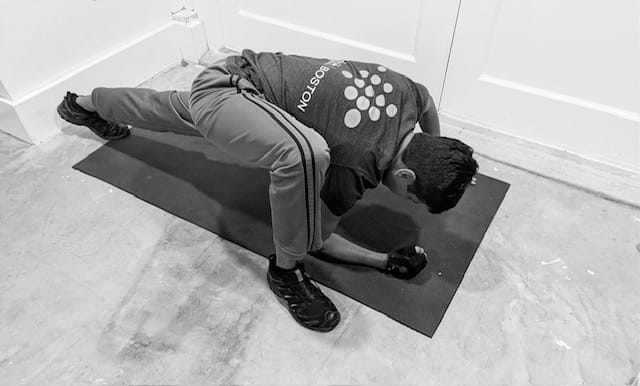
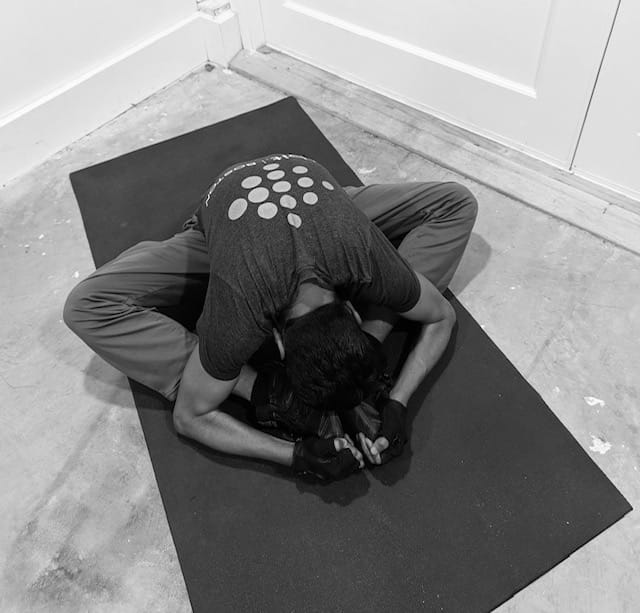
I can see the increased flexibility most dramatically in the "butterfly stretch" (below.) You used to have your knees very close to your ears.
I did. That's been a dramatic change. It's a great example of how flexibility can improve and how sitting for a long time really affects your body.
So, let's talk about "exercise snacking," which is one of my favorite fitness topics. I've written about it before: https://beneath-the-skin.ghost.io/the-perfect-exercise-snack-heres-a-hint-its-not-chewable-2/
The topic of exercise snacking came up because I was really kind of perplexed when I was training you. You work out really, really hard once a week with me, and you play with your kids on the weekends.
Yep, pretty much.
You don't go to a gym.
Nope.
And that's the extent of it, or so I thought. And yet, given that relatively little amount of movement, you always come to the session in good shape. No rust. Also, you never seem to gain weight, even though — how to say this — your diet isn't the exact definition of "pristine."
(laughing) Yeah, that's true. My favorite desserts are rasmalai (milk cream and cottage cheese based Indian desert) and rasgulla (sugar syrup + cottage cheese balls). I have them several times a week. I also have three or four alcoholic beverages during the week. So, my diet isn't horrible, but it's not going to win any awards. (laughs)
Right. So, I'm looking at the amount of energy you're expending on a weekly basis and the amount of energy you're taking in, and things weren't adding up.
(laughing) I'm a man of mystery I guess.
I really wanted to get to the bottom of this — as both a trainer and a journalist. In passing, I asked you what kind of movement you got during the work day, and you said you tried to take the stairs.
Yeah.
And when I asked you how many stairs you took during the day, you casually said "oh...about four or five hundred a day." (laughs)
(laughing) Well, now that I'm being interviewed, it does sound kind of excessive.
And this is all part of your work day. In other words, you're not doing the stairs just to do them.
No, completely unintentional. I take the stairs every time I go to lunch or meet a colleague. Or when I take a break in the afternoon to go to the Chai Indian tea stall. I work on the fourth floor at the Google Campus, and there's about one hundred stairs to reach the floor. I do it 4-5 per day.
How long have you been doing this for?
For most of the past year.
Was it difficult to maintain that regimen?
At first it was a little difficult. My heart rate was really elevated and I got really sweaty pretty quickly.
I'm reminded of a "Mad Men" episode where one of the executives had to take about ten flights of stairs because the elevator was broken. Those were the three martinis and steak lunch days. I think he has a heart attack when he reaches the top.
I've gotten a few looks. You know ... some people thinking "this guy's some kind of an exercise fanatic" or something like that.
(laughing) Or maybe they think you're a Luddite and use a flip phone.
(laughs) That would be ironic, given my workplace.
How long did it take you to get comfortable in the routine?
Maybe a few months. After about three months, I didn't even think about it anymore. And it's given me the same benefits of standing: increased energy, an increased ability to focus, and a lot more flexibility.
I'd like to wrap things up with some final thoughts on your fitness journey.
Yeah. Fitness doesn't require a mirror. Happily, I got over that misconception many years ago. I also realized how crucial movement is for my mental well-being. It goes hand-in-hand with not allowing my body to decay. So, I think I've arrived at a place that's really sustainable and holistic.
Movement is a part of my life. It's not a chore or a separate part of my identity. It's ingrained in me. Just like eating or spending time with my family.
Thanks for spending time with me today, Sukhendu.
Thank you, Josh. My pleasure.
Member discussion